Justice
Perceptions change justice and what we allow to take up space in our conversations, resources, and time. Justice is reflective of our individual, community, and societal values. It can make amends, provide retribution, discipline, surveil, take form as reparations, and serve as cultural placemaking. The perceptive of compulsory justice can influence actions based in law. Each perception of Justice works together to challenge what is knowledge, retribution, punishment, and value. Justice provokes us to extend our understanding of what “knowledge” is and how “valued” knowledge contributes to just action. It also challenges us to consider what knowledge is not valued and therefore left of out the conversation.
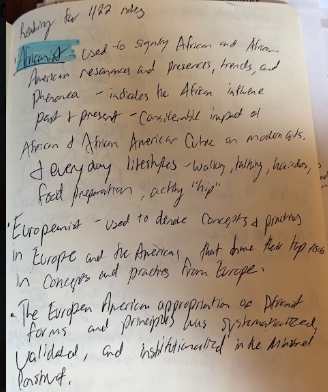
We started the spring semester by looking at Africanist influence, both past and present, compared to Europeanist appropriation. Brenda Dixon Gottschild’s “Digging the Africanist Presence” discussed how African and African American culture has had a significant impact on modern culture on everything from art to daily lifestyles like food preparation, walking, and talking. Humes has explored this theme further through Dr. Corso-Esquivel’s plenary lectures on Africanist influence on art, and Dr. Bory’s on Africanist influence on dance and performance. Despite the considerable impact Africanist culture has had on Europe and America, no credit is given and the culture is often mocked and appropriated.
Another space where this appropriation is viewed is through the systematization, validation, and institutionalization of minstrelsy in America that we saw in Marlon Riggs “Ethnic Notions.” America has indulged in Africanist culture and spaces. The culture continues to be consumed, but Africanist appropriation and a domination of Europeanist ideology prohibit African and African American communities from receiving recognition as justice. Justice is valued knowledge and cultural recognition.
Justice is a reflection of our morality, but our morality is not objective. In Peter Singer’s “Famine, Affluence, and Morality” he states that his morality, to promote happiness and prevent suffering, is uncontroversial because it is undemanding (231). Other consequentialists, like Singer, base their morality off of the consequences that actions will cause, but do not consider specifically happiness. Injustice is defined differently among people and communities. Perceptions of morality change views of “just” action and rectification. To define “just” action, unjust action must also be defined. In the spring semester, Dr. Wills stated that “injustice is brokenness. Justice is the default.” Calls for Justice are space for new knowledge and understandings of injustices to arise.
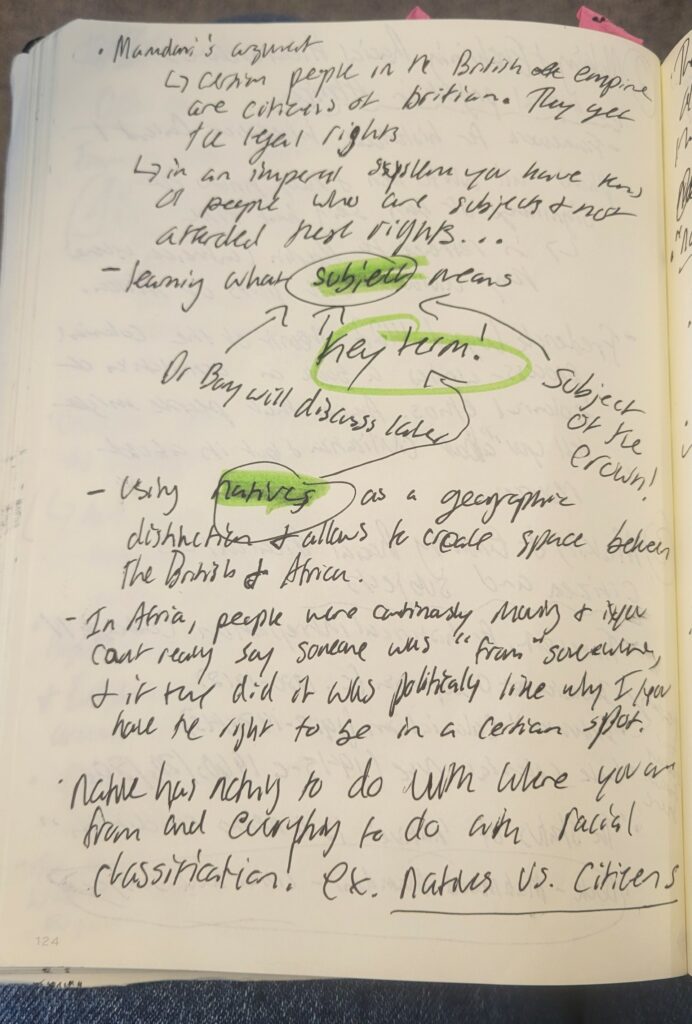
Justice is systematically reproduced. This notebook page connects to the same idea of social constructs and how it has connected to African studies, specifically how the British and African people view labels differently and how they benefit or harm them. The British began labeling Africans as “natives” and labeled the British colonizers as “citizens.” Dr. Wiemers explained how this language did not resonate or reflect the African people because it did not align with how often they moved and how they valued the locations they occupied. The labels also restricted equal access to rights, leadership, and property in the African people. This example is reflective of the larger idea that social constructs develop different perspectives and eventually concepts of what is just. Another example includes the attempts at retribution with the Truth and Reconciliation Trials (TRC), where providing space for accountability is valued in legal systems.
The TRC views justice through the lens of first identifying injustice and then allowing that admittance to be rectified between the harmer and the harmed. Conceptualizing and defining justice cannot be objective. Justice must consider collective memory, structural and societal constructs, and each perspective of both community and individuals.
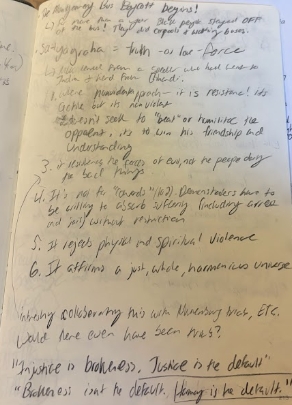
Justice is resistance. Dr. Wills introduced the idea of passive resistance through the civil rights movement and the ACT UP movement. We analyzed justice through images, art, and history by reading “March 2” and “Seven Miles a Second.” Justice is fueled in many cases by activism and advocacy to address harms towards certain communities. In these graphic novels, historical documentation works with illustrations to allow readers to grapple with the severity of injustice they faced. While visualization serves as a clear entry point to understanding injustice, it brings questions to why we must view an injustice for it to be important. Despite this, visualization can serve as a form of resistance against unjust systems.
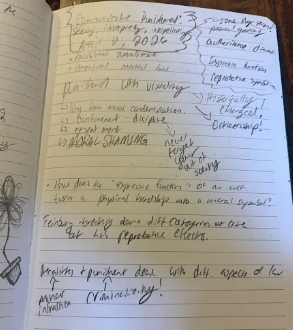
Justice challenges existing forms of punishment, surveillance, criminalization, and power. Dr. Corso-Esquivel introduced the idea of expressive function and how it develops physical hardships into moral symbols. Expressive function works to separate opposing ideas via moral shaming, promoting resentment, and distinct categorization. By shaping opposing perspectives as a moral attack, conversations about Justice hit a roadblock. Threats to morality can lead to confinement in order to maintain “status quo” or avoid conflicts (even if those experience injustice must live in a state of conflict). Avoiding injustice is privilege.
During Dr. Corso-Esquivel’s lecture “Communicative Punishment: Seeing, interpreting, interpellating” on April 2nd, he stated that “conscious punishment we see… but the most painful part is the unconscious. ” Justice functions similarly. We can see the institutionalized forms of Justice in society. We can see systems set up to punish, discipline, and correct across the world. But the most important part of Justice is not seeing, its listening. It’s being aware of the injustices that exist in our communities and the injustices we do unto others. Justice requires us to do more than just blindly accept traditional-legal legitimacy. Justice requires continuous learning, questioning, returning, and action.
