Writing Assignment #1
Annotating a Text: Famine, Affluence, and Morality
Paragraph 1,
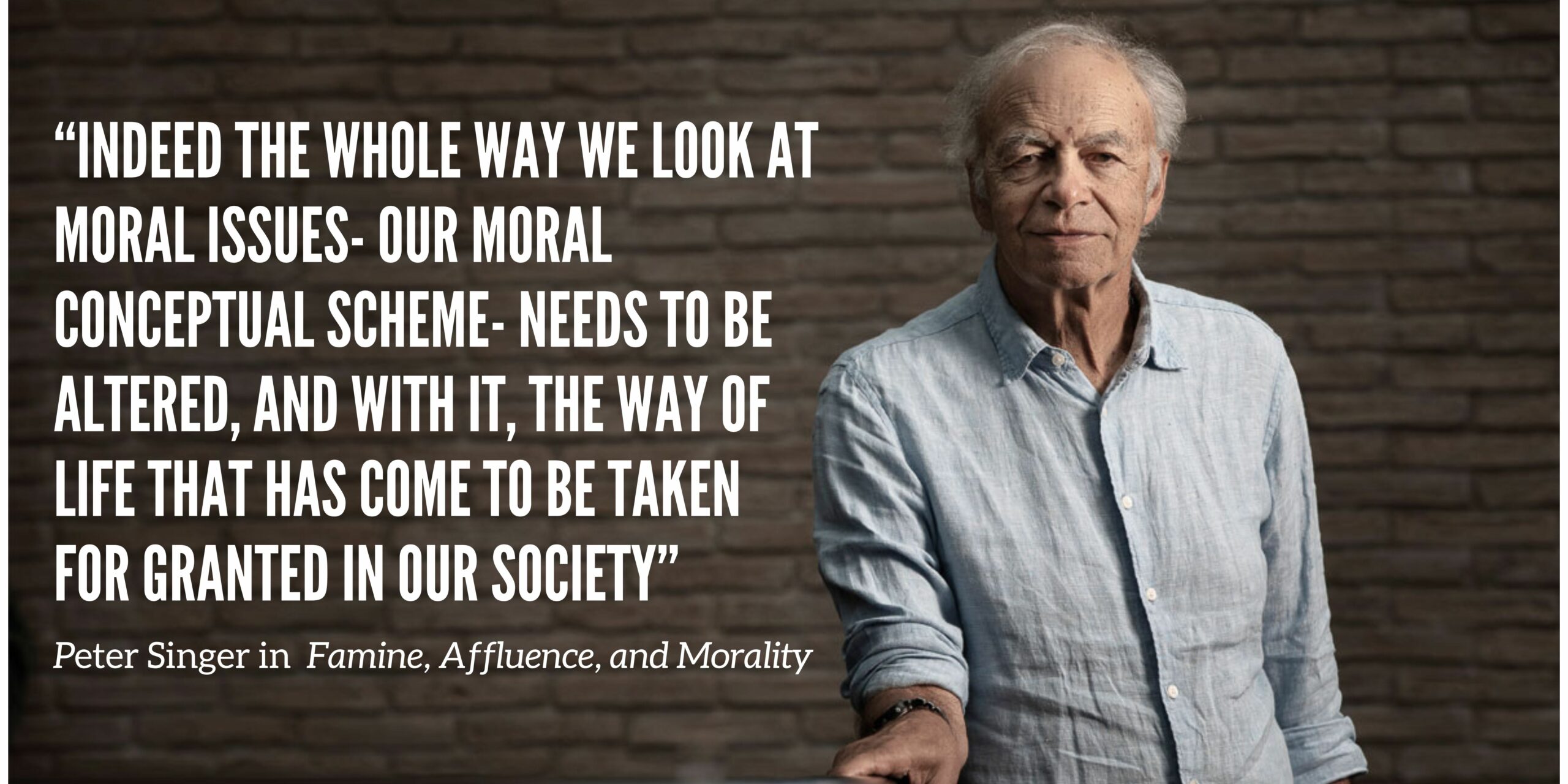
Throughout “Famine, Affluence, and Morality” Peter Singer repeats his usage of the word “ought” with “morally following directly after to support his argument for morality. The significance of the word “ought” is developed through Singer’s conception of morals, in which he calls for those in better positions to provide assistance to others, if able to do so without sacrificing something of comparable moral importance (231). Singer formulates the notion that his positionality is so fundamentally inarguable that anyone more affluent than another has a duty to complete it without regard to other confines of their own morality. Singer provides an example of defying any other morality when he states, “If I am walking past a shallow pond and see a child drowning in it, I ought to wade in and pull the child out. This will mean getting my clothes muddy, but this is insignificant, while the death of the child would presumably be a very bad thing” (231). Singer uses a straightforward example to connect his morality to a real-life situation. He does not consider arguments like the value of the clothing that he is wearing or if he will be running late to work or school because he needs to save the kid. This is because he would not be sacrificing something of comparable moral value to the death of a child. The suffering of the child would be more than the suffering of having to buy a new pair of sneakers.
Paragraph 2,
Within “Famine, Affluence, and Morality,” Peter Singer calls for collective action from the more affluent in both individuals and governments. Referring to the Bengal emergency, Singer states “Neither individuals nor governments can claim to be unaware of what is happening there” (230). This quote expresses how a precarious attempt must be made to avoid information about major world crises, and therefore individuals or global powers cannot claim to be unacquainted as an excuse to not provide assistance. Along with shutting down any inadvertent ignorance of world problems as an excuse to not assist, Singer shuts down any excuses stemming from location. Singer states “For the principle takes, firstly, no account of proximity or distance” (231). This claim is reminiscent of Martha Nussbaum’s idea of a global citizen. Nussbaum states that everyone, despite distance, has an obligation to assist other citizens of the world. We should have just as much of a commitment to someone living in a distant nation as we do to our next-door neighbor (Nussbaum 10). Combining Singer’s call to action for both individuals and governments with his accounts of ignorance and distance develops exactly who Singer’s moral scheme is targeting.
Paragraph 3,
In “Famine, Affluence, and Morality” Peter Singer argues that his moral principle is simple, agreeable, and undemanding because it only requires us to prevent bad, and does not require us to promote what is good. He then states “I will henceforth take this assumption as accepted” (231). Singer does not invite any arguments against his morality. In his perspective, what he is asking is simple and requires little of us because our sacrifices are not morally comparable to the suffering we must sacrifice for. His morality is to simply promote the welfare of most people while harming the least amount. Singer also states that “The uncontroversial appearance of the principle just stated is deceptive” (Singer 231). His principle is “deceptive” in the way it is simple, yet we choose to make it complicated by attempting to disprove his arguments. Any opposition to his morality is challenged by his simplicity in requests and “Those who disagree need read no further” (231).
Works Cited
Nussbam, Martha. Cultivating Humanity: A Classical Defense of Reform in Liberal Education, 1997. Introduction.
Singer, Peter. “Famine, Affluence, and Morality.” Philosophy & Public Affairs, vol. 1, no. 3, 1972, pp. 229-43, https://www.jstor.org/stable/2265052. Accessed 26 September 2025.
