Letter to Archives
Dear Davidson College Archives & Special Collections,
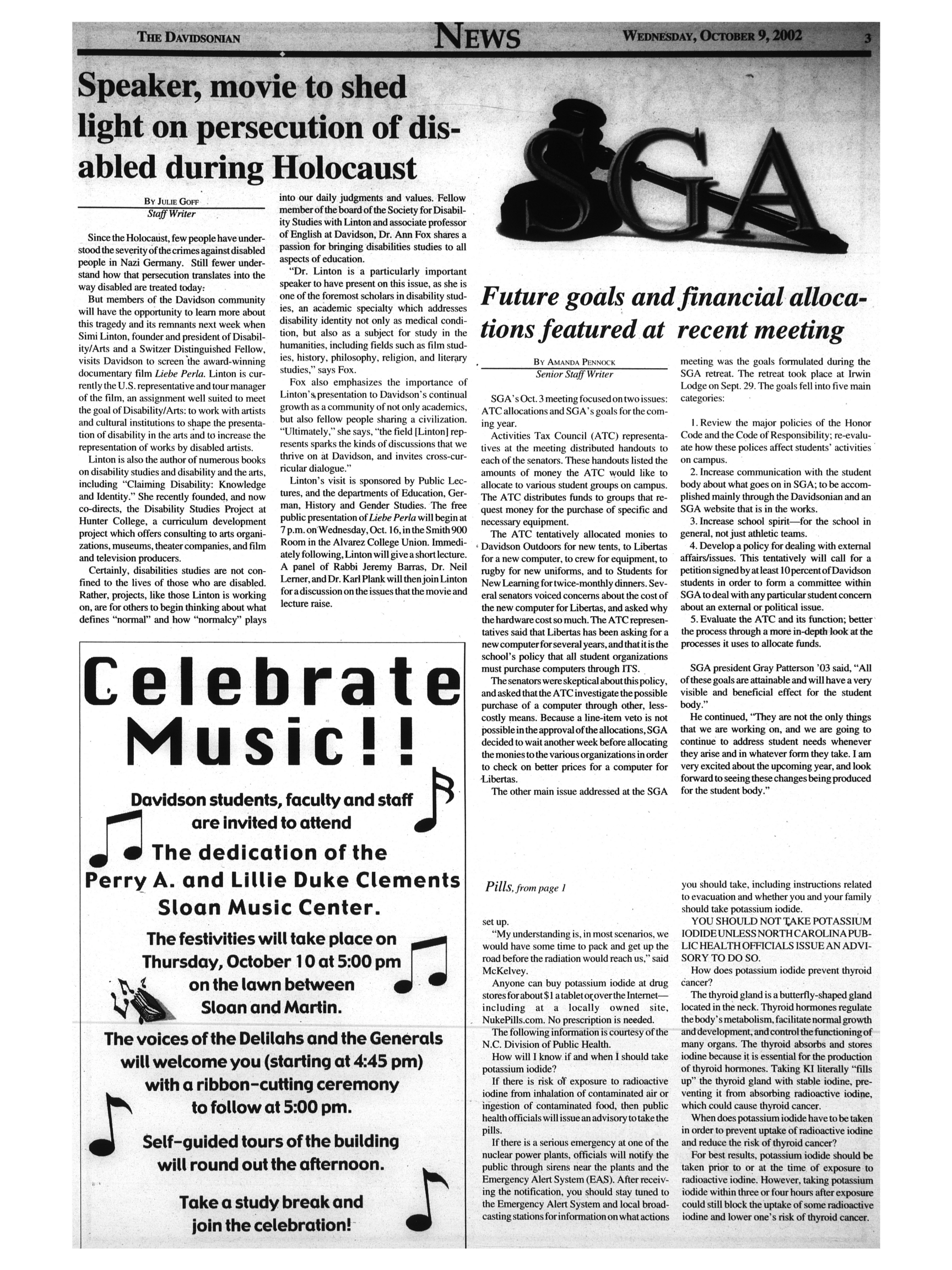
The way that history is perceived, valued, and expressed is influenced by every community that interacts with it. The Davidsonian, which has been diligently preserved through years of your archivist efforts, serves as a significant primary source in analyzing the role that Davidson has taken in addressing injustices. The Davidsonian’s material is directly impacted by the values of the Davidson community and student body at the time of the publishing, which reflects institutional admissions values, funding considerations, and mission statements. Inspired by the listed factors, I am requesting access to the preserved Davidsonian edition that was published on Wednesday, October 9th, 2002. This source would serve as a crucial component of my investigation into how North Carolina’s liberal arts colleges differ in their approaches to addressing historic disability discrimination.
As a current Davidson student involved in the first-year Humanities program, I seek to ground my hypothesis in primary sources from North Carolina’s liberal arts colleges. Educational institutions have varying perspectives, missions, and funding that shape the platforms that are provided in order to address historical injustices. I hypothesize that by identifying the trends or differences among North Carolina’s liberal arts colleges, further research could be conducted to identify barriers to disability advocacy in the state’s higher education system as a whole. Thank you for your consideration.
Buried Standards in Ability, Admission, and Action
Injustice is addressed in higher education solely within institutional constraints like space, funding, and values and the condition of student body schedules, integrity, and interest. Every higher education institution located across the globe has a different calibration of all of these factors, leading to different approaches in addressing injustice. Davidson College, being a small southern liberal arts college, has a perspective unique from others, even colleges a couple miles away. Due to factors like historic involvement and donor input, the way that injustice is addressed is not objective. This paper aims to analyze how North Carolina’s liberal arts colleges differ in their approaches to addressing historical disability discrimination due to student involvement, stated institutional missions, medium, and southern status.
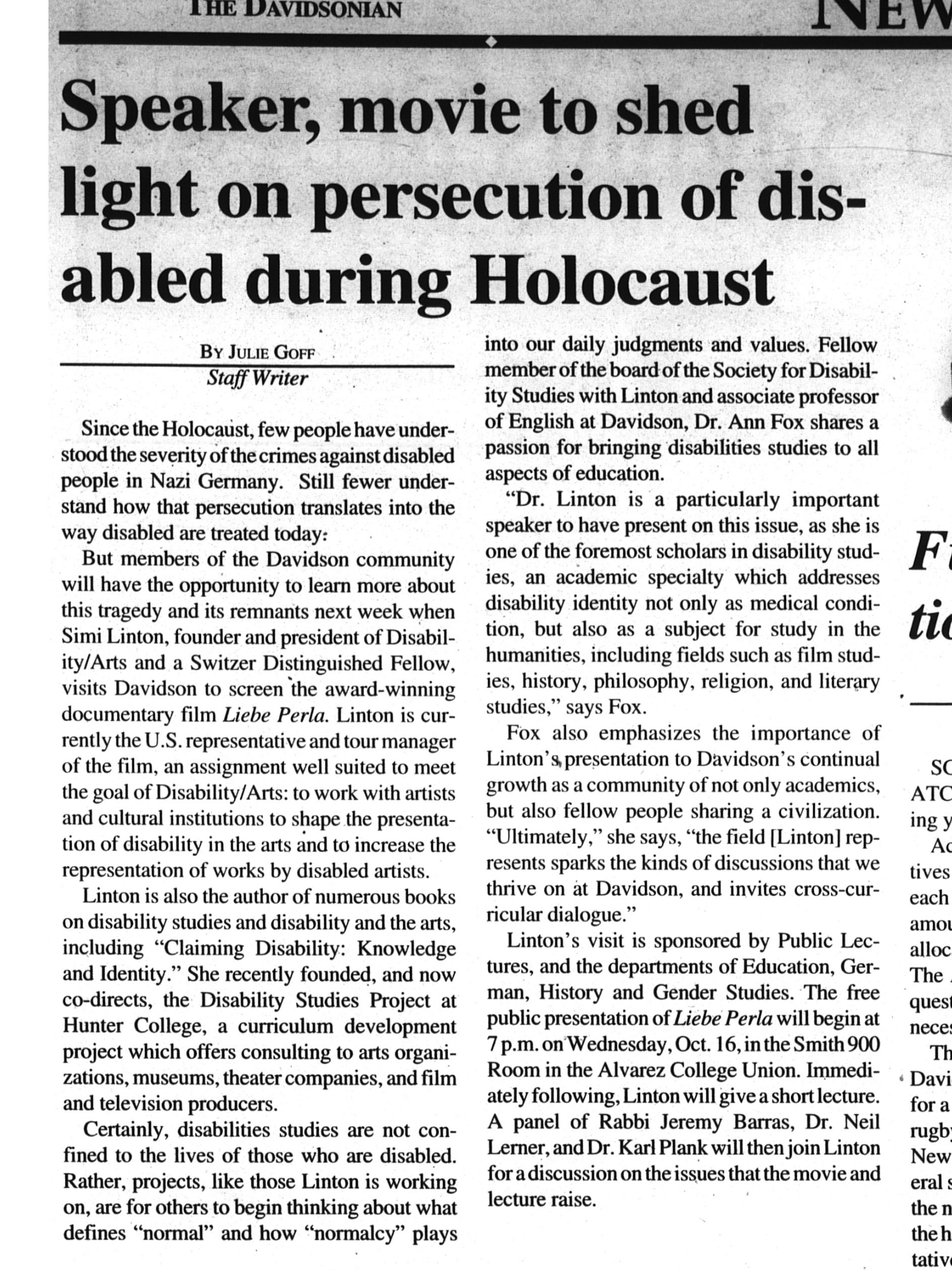
On Wednesday, October 9th, 2002 The Davidsonian published the weekly newspaper with a section addressing an upcoming event titled “Speaker, movie to shed light on persecution of disabled during Holocaust” written by staff member Julie Goff. This section informed students of an upcoming screening of an award winning documentary called Liebe Perla. This screening was followed by a short lecture from the US representative and Tour Manager of the film, Simi Linton. Analyzing this primary source is important because of the role that The Davidsonian plays on the spread of information across campus and in the Davidson community. The Davidsonian is student run and edited, which means anything published in it reflects aspects of the Davidson student body. If this article was written 30 years earlier, Davidson would not yet be coeducational and would be perceived by only male students. This source is unique to Davidson and the role it adopts as a liberal arts college. Other North Carolina liberal arts colleges have different admissions standards, and ultimately student bodies, which changes the way that historic disability injustices are addressed.
This section of The Davidsonian states that faculty invited the theme of historical disability discrimination onto its campus to shift students’ understanding of what is “normal” (Goff). Several of Davidson’s departments including Education, German, History, and Gender Studies sponsored this screening of the event, revealing that the goal of redefining “normality” was an interdisciplinary effort (Goff). Davidson is a liberal arts college that advocates for its students to be involved in interdisciplinary studies whether it is through the “ways of knowing” requirements, or its invitation to events like this screening. While disability is typically studied through physical aspects, Davidson faculty hoped that this screening would invite disability studies as a humanities subject (Goff). The unique combination of Davidson’s department sponsorship, specialized interdisciplinary curriculum, and the humanities focused lens anatomises why the screening happened at Davidson, and why it was approached with the goal of redefining normality. Other North Carolina liberal arts colleges have different missions, like for example being research focused, that would ultimately shift how conversations about historic disability injustice arise. Memorialization, rectification, or equalization may be alternative objectives.
The medium that different North Carolina liberal arts colleges use to interact with historic disability injustices also builds upon institutional missions. The screening of Liebe Perla was a one-time event. It did not invite disabled students to interact with audiences and provide commentary. It did not advertise a continuous goal of expanding upon curriculum by introducing new faculty or new classes to address continuous injustices on campus. There was not a display of physical art with which students and community members could interact with for a continued period of time. This does not mean that a screening of a film is unimportant, but that Davidson’s choice to show the film over other forms of mediums does highlight some voices while excluding others. These same questions can be asked about the approaches of other North Carolina liberal arts colleges to determine what and who is being left out of the conversation, and what needs to be changed about institutional approaches.
Examining this document in the context of North Carolina’s liberal arts higher education institutions is important because of the south’s historical oppression and harm towards disabled communities. While this specific Davidsonian archival document does not address a specific injustice that happened in North Carolina, it is useful to analyze how the topic is brought up in an area that has historically harmed the same community of people. Throughout southern states, Americans with disabilities have been both socially and economically marginalized (ADL). People mistreated Americans with disabilities because they were viewed as “unfit” or “unable to contribute to society (ADL). These harmful ideals spread across the nation and left Americans with disabilities impoverished and mistreated. How different North Carolina liberal arts colleges approach addressing historical injustices towards disabled communities, considering their community’s historic exacerbation of those same injustices, allows for the recognition of remnants of prejudices and oppression.
Works Cited
ADL Education, “A Brief History of the Disability Rights Movement.” ADL, 22 Nov. 2024, www.adl.org/resources/background/brief-history-disability-rights-movement
Goff, Julie. “Speaker, movie to shed light on the persecutions during the Holocaust.” The Davidsonian, 2002-10-09. Davidson College, 2002.
